



































You are looking at the documentation of a prior release. To read the documentation of the latest release, please
visit here.
KubeDB Platform API Reference
The KubeDB Platform API Server is the backend server of the KubeDB Platform. This page gives you both the whole-system picture — what the server does, how it is put together, how requests are authenticated and authorized, and how the pieces fit into typical flows — and the entry point to the low-level, endpoint-by-endpoint reference. Every endpoint on the per-group pages lists its HTTP method, path, authentication, path/query parameters, and request/response shapes so you can implement a client directly against it.
All routes are served under the /api/v1 prefix unless noted otherwise. The
marketplace webhook service is a separate listener rooted at /marketplace/api/v1.
A machine-readable OpenAPI 3.0.3 specification of this API is
also available (openapi.yaml) — load it into any OpenAPI tool (Swagger UI, Redoc,
openapi-generator) to explore the API or generate a client. A self-contained,
interactive Swagger UI viewer (with the spec inlined) is also
published for this release — open it to browse and try every endpoint in the browser.
Overview
The KubeDB Platform API Server combines an identity foundation (users, organizations, teams, authentication) with a multi-cluster Kubernetes management platform providing:
- Identity & access management — users, organizations, teams, fine-grained authorization.
- Cluster management — import, provision, and operate Kubernetes clusters (hub/spoke via Open Cluster Management, Rancher, cloud providers).
- A full Kubernetes API proxy — the KubeDB Platform UI talks to member clusters through the KubeDB Platform API Server.
- Licensing & contracts — issuing and enforcing product licenses (KubeDB, KubeStash, KubeVault, Voyager, …).
- Billing & usage reporting — usage aggregation, invoices, cloud-marketplace metering (AWS/Azure/GCP).
- Monitoring & telemetry — telemetry stack provisioning, Prometheus/Trickster auth proxying.
System Architecture

Key runtime facts:
- One binary, multiple subcommands. The default command is the API server;
marketplace,monitor,aggregator, andsummaryrun as separate processes for async/billing workloads. - NATS/JetStream is the event backbone: member clusters push resource/usage events;
monitorandaggregatorconsume them; the API server also uses NATS for its task manager and per-user credentials. - FluxCD (HelmRelease) and OCM (ManagedCluster) are used to deploy KubeDB Platform features onto clusters and to manage hub→spoke relationships.
- Deployment modes are switched by
DEPLOYMENT_TYPE: AppsCode-hosted, self-hosted (incl. offline installer), or AWS/GCP marketplace deployments. Some API groups only exist in specific modes (noted below).
Authentication & Authorization
Most endpoints require a personal access token. Send it as an HTTP header:
Authorization: token <YOUR_TOKEN>
You can also pass it as a token or access_token query parameter. Token-management
endpoints accept HTTP Basic auth. The web console uses a session cookie
(i_like_ace); a session cookie alone does not authenticate the token-guarded
REST endpoints — use a token.
The server supports several authentication mechanisms:
| Mechanism | Used by | Notes |
|---|---|---|
| Session cookie | Web console | Cookie-based sign-in; CSRF-protected |
| Personal access token / Bearer token | API clients, CLI | Authorization: token <t>, ?token=, ?access_token= |
| Basic auth | Token management endpoints | With optional OTP (2FA) |
| OAuth2 / OIDC | SSO; the KubeDB Platform API Server is both provider and consumer | /login/oauth/*, /.well-known/openid-configuration |
| LDAP / PAM | Enterprise sign-in sources | Configured by site admins |
| 2FA / WebAuthn | User accounts | TOTP, scratch tokens, security keys |
| License-based auth | Member clusters | Clusters authenticate with issued licenses / cluster tokens |
| Sudo | Site admins | Impersonate a user via sudo param/header |
Authorization is relationship-based (OpenFGA-style checks, shown as authzCheck(<permission>) in the
reference tables). Common middleware referenced in the API tables:
- Token — authenticated request required (
reqToken). - Site admin — platform administrator only.
- Org context — org resolved from path or
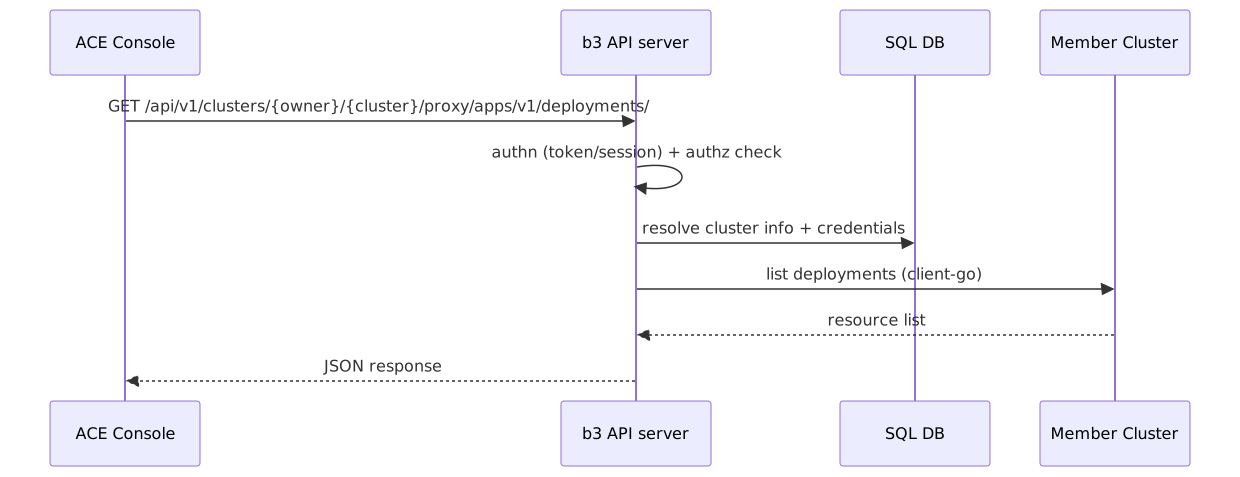
?org=query; membership/ownership verified. - Cluster assignment — resolves owner+cluster, loads cluster credentials, builds a Kubernetes client.
- Public — no authentication beyond baseline middleware.
Baseline middleware on every /api/v1 route: optional-sign-in, NATS connection cleanup,
security headers (nosniff), API context, sudo support.
API Groups
The v1 API surface is organized into the following logical groups:
| # | Group | Base path(s) | What it covers | Availability |
|---|---|---|---|---|
| 1 | Identity: Users & Settings | /api/v1/user, /api/v1/users | Accounts, profile/security settings, tokens, credentials | always |
| 2 | Identity: Organizations & Teams | /api/v1/orgs, /api/v1/teams | Orgs, members, teams, org tokens | always |
| 3 | Administration | /api/v1/admin, /api/v1/accounts/admin | Admin console, site settings | always |
| 4 | Authorization (Roles & Permissions) | /api/v1/authz | Custom roles & permissions | always |
| 5 | Cluster Management (v1 + K8s proxy + Helm) | /api/v1/clusters | Cluster lifecycle, Kubernetes proxy, Helm | always |
| 6 | Cluster Management v2 | /api/v1/clustersv2 | Hub-aware cluster API, subscriptions, gateways | always |
| 7 | Multi-cluster (OCM hub/spoke) | /api/v1/clusters/:owner/:cluster/... | Hub/spoke, cluster sets, feature sets | always |
| 8 | Client Organizations | /api/v1/user/client*, /api/v1/clusters/.../permission | Managed-service client orgs | always |
| 9 | Cloud Providers | /api/v1/clouds | Provider discovery for provisioning | always |
| 10 | Platform Installer | /api/v1/ace-installer | Self-host installer bundles | AppsCode-hosted only |
| 11 | Platform Upgrade | /api/v1/upgrade, /api/v1/clusters/.../upgrade | Platform & cluster upgrades | always |
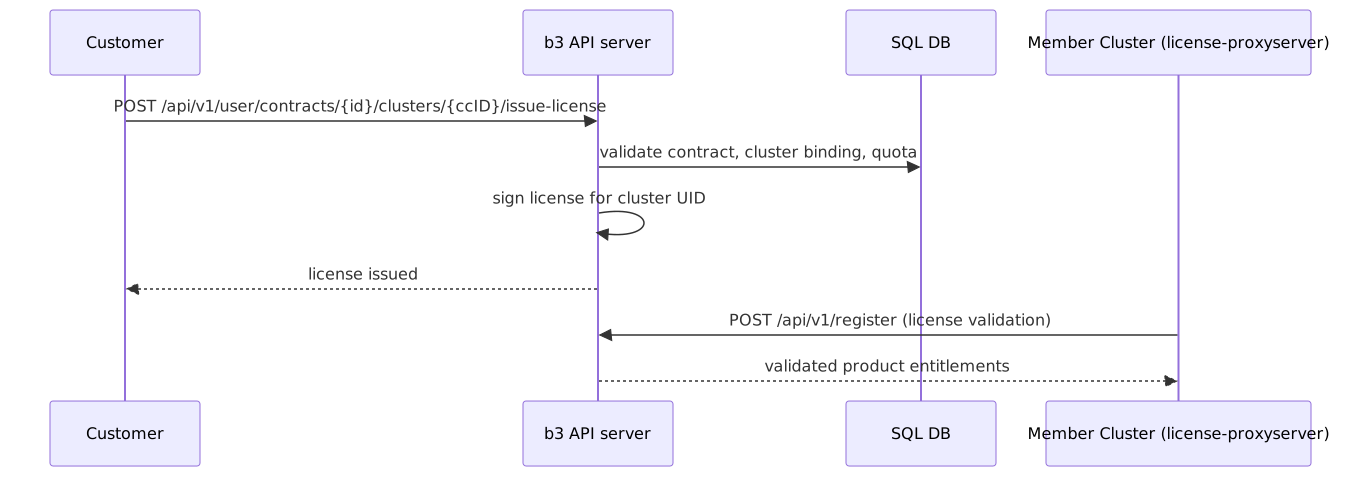
| 12 | Licensing & Contracts | /api/v1/contracts, /api/v1/user/contracts, /api/v1/register, /api/v1/license | Contracts, licenses, registration | contracts: AppsCode-hosted |
| 13 | Billing Dashboard & Usage Reports | /api/v1/dashboard, /api/v1/user/dashboard, /api/v1/dbaas | Usage reports & billing dashboards | billing-enabled deployments |
| 14 | Marketplace | /api/v1/marketplaces (separate service), /api/v1/proxy/metered-billing | Cloud-marketplace webhooks & metering | marketplace deployments |
| 15 | Monitoring & Telemetry | /api/v1/telemetry, /api/v1/trickster | Telemetry stack, Trickster auth proxy | always |
| 16 | Rancher Integration | /api/v1/rancher | Rancher sync & proxy | always |
| 17 | Helm Chart Repositories (public) | /api/v1/chartrepositories | Public Helm chart repositories | always |
| 18 | Miscellaneous & Site Settings | /api/v1/version, /api/v1/markdown, /api/v1/branding, … | Version, markdown, health | always |

Typical Request Flows
Cluster resource access via the Kubernetes proxy
License issuance for a contract cluster
Usage → billing pipeline

Deployment Modes
| Mode | DEPLOYMENT_TYPE | Notes |
|---|---|---|
| AppsCode-hosted (SaaS) | Hosted | Full surface incl. contracts admin, installer, Firebase tokens |
| Self-hosted | SelfHostedProduction (offline installs also set the separate OfflineInstaller flag) | Runs from a generated installer bundle; /selfhost console URL |
| AWS Marketplace | AWSMarketplace | Marketplace webhooks + AWS metering proxy enabled |
| GCP Marketplace | GoogleCloudMarketplace | Marketplace webhooks + GCP metering proxy enabled |
| Azure Marketplace | AzureMarketplace | Recognized marketplace mode (webhooks); no metering proxy wired up |
Feature gating summary:
AppsCodeHosted→ contracts admin APIs, installer APIs, org claim, Firebase token.IsBillingEnabled()→ billing dashboard APIs (admin, user, usage reports).DeploymentType→ which marketplace metering proxy (if any) is registered.- License enforcement is compiled in (
ENFORCE_LICENSE=true); the server validates its own license at startup.